photo

photo
Photo by Rebecca Gould Photography

Wednesday, August 13, 2014

Operating Instructions

How do you instruct someone in subtleties you are only just starting to understand yourself?

As we prepared to allow Susan to spend an afternoon, night and most of the following day (so there was no getting around the fact that she would have to take a peanut dose while away from us), I struggled with this question.  

I wondered if I was crazy to entrust my child to another?  
(Even a parent of a child with food allergies...who also happened to be a doctor.)

I reminded myself that Susan has always refused to be defined by her food allergies.
(I reminded myself that we DO NOT want her to be defined by her food allergies.)

I stared at my computer screen, trying to find the words that would ensure my daughter's safety.  All the while, a part of me wondered why I would take such a risk...while another part of me asserted that the risk was not so great, and that the only way we could see ourselves through the clinical trial was to try to find some sort of balance.

As I am sure any parent of any child (and most especially those with a child with special needs) can attest, there are certain things a parent knows that they...well, just know about their child.  A parent sees things in their own child that others -- even those looking carefully and listening attentively -- will miss.  That's just the nature of the relationship between a parent and a child.  And so I wrote, and I edited, and reviewed with my husband and finally...I decided I just had to...trust the universe.

Susan's "operating instructions" were entitled "Susan's Peanuts."


Peanut Dosing Instructions


1) In the morning, with breakfast, Susan should take:
            10 mg Zyrtec
            20 mg Famotidine

2) One hour before dose, Susan should take:
            20 mg Omeprazole     

3) Preparing Susan's peanut dose:
            -- Place the taller Bullet Blender Cup on the counter in advance
               (this will allow pre-measured peanut protein and chocolate whey to settle)
            -- Fill the cup with milk (leave about 1/4 inch at the top)
            -- Blend using the Bullet Blender base
                (Do not run for more than 60 seconds continuously -- mix well, please)
            -- The short Bullet Blender Cup is a back-up, just in case something goes wrong

4) The peanut dose:
            -- Susan should have a small snack just before she takes her peanut dose
            -- Please check Susan's skin (cheeks, chest, back) just before she takes her dose
            -- I packed ones that she likes in the bag with her peanut dose
            -- Susan drinks her peanut dose with a straw (in the bag)
            -- She will need to lick the blender blades in addition to drinking the dose
            -- Once she has finished the dose, please pour milk down the sides of the cup to                       ensure she gets as much of the dose as possible. She will drink that, too.
            -- No need to wash it -- just screw the top on and send it home with Susan!

5) The 2-hour observation period
            -- Calm, quiet activity (movie, reading, board game, craft)
            -- Check Susan's skin (cheeks, chest, back) every ten minutes (I use the snooze                          function on my phone)
            -- At each 10 minute mark, ask Susan how she feels -- be sure she really thinks about                 that question
            -- Please complete the dosing journal (in the bag)

6) In case of reaction
            -- Skin changes -- observe.
                We have not treated skin changes.  It is best to watch to see what is                                     happening.  Susan can tolerate some itchiness and they have historically                               resolved without intervention (eventually, even if not right away)
            -- Nausea -- provide support, coach relaxation, remind Susan that she has tolerated                   this  dose
            -- Vomiting
                Provide support.
                Call on-call doctor for clinical trial.
                It is likely that you will not do anything else.
            -- For any other symptoms, it is preferred that you contact the on-call doctor for                       the clinical trial first, as their goal is not to provide medical intervention (such                     as Benadryl) that might mask other symptoms. 
            -- In the case of rapidly progressing symptoms such as difficulty breathing or                             sensation that her throat is swelling, administer Susan's Epi-Pen and page the                       doctor on call for the clinical trial.  In the case of an emergency, get her the help                 she needs and then contact us.

We have found that Susan does best if she has a mid-morning and mid-afternoon snack.  She has a variety of options -- it doesn't have to be much, just something so that her stomach is not empty.


That was it.
1 1/2 pages.
So much information, and yet...so little.


At the bottom, I provided both my and my husband's cell phone numbers and witnessed permission for the Hertz family to seek medical care for Susan if need be.  As I signed in front of a witness, I felt slightly ill.  I so hoped there would be no need for anyone ever to look any more closely at that piece of paper than we had...

The Clinical Trial Coordinator and doctors knew about and supported the plan.  Everyone knew how to reach everyone.  

Wanting to believe, but worried about the unknown (both for Susan and for Lydia and her family), we dropped Susan off at Lydia's house on Friday afternoon...and headed toward Bemidji, Minnesota.

Tuesday, August 12, 2014

Letting Go (Ever So Slightly)

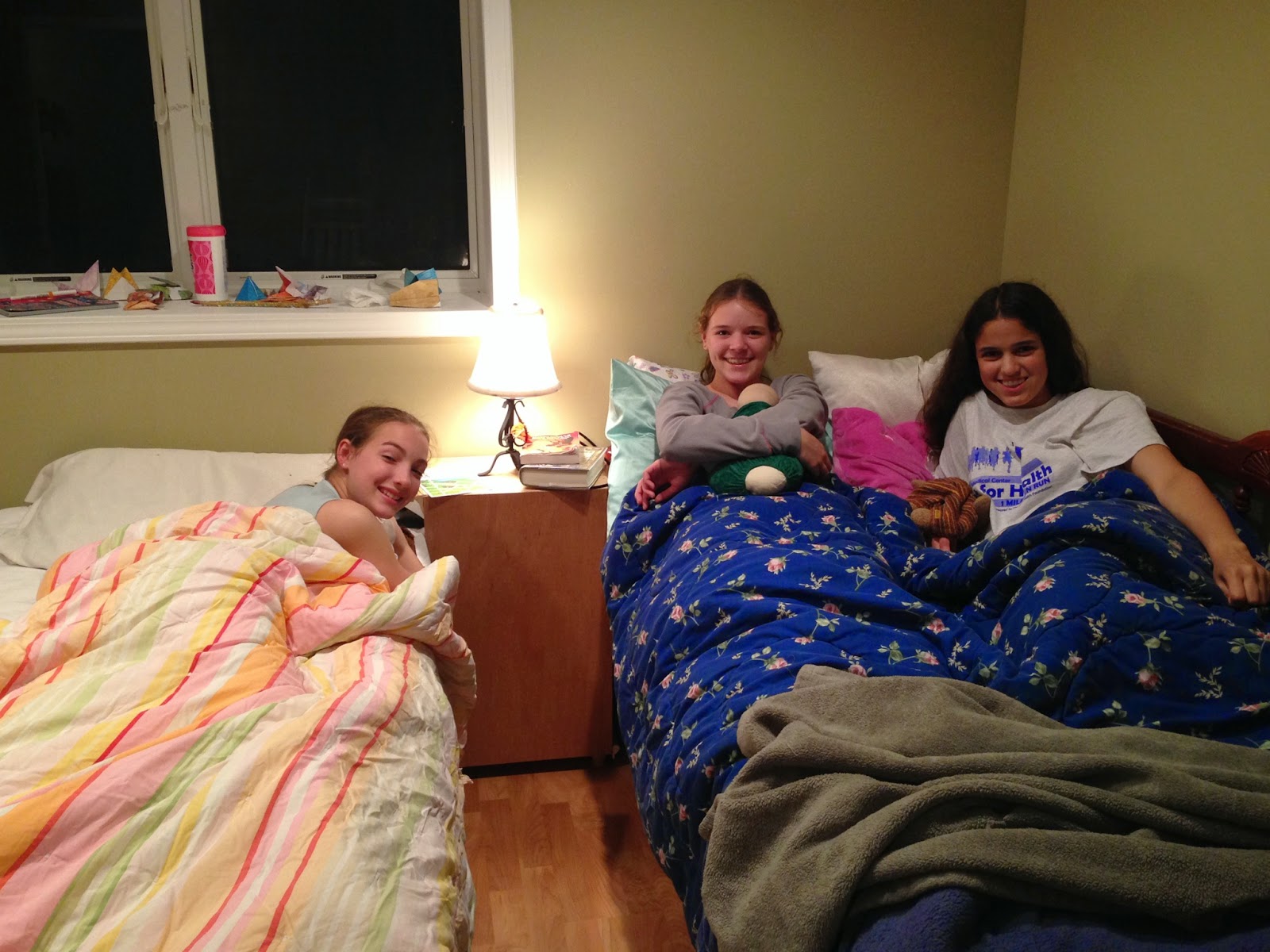
I always know when Susan does not want a play date, a visit or a party to come to an end, because she asks for a sleepover.  Sleepovers, in food-allergy-land, are a very difficult proposition, and while we have hosted many, she has only slept over at a very few places.

The Saturday night of the FARE conference, Susan and Lydia asked if Susan could sleep over in Lydia's hotel room.  I don't know if they had asked Lydia's mother, who might well have agreed, but I was pretty sure Susan needed a real rest.  And after the struggle she had to tolerate the 45 mg dose earlier that evening, I was not prepared to leave her with anyone.  So, I said "no" (as gently and kindly as I could)...because I could feel the power of the new connections...

And I made an honest promise to Susan and Lydia that we would find a time for Susan to sleep over with Lydia in the very near future...knowing in my heart of hearts that as honest as the promise was, it would be harder than I might like to keep that promise. (Honestly, at the time, I could not IMAGINE how I would keep the promise, knowing only that I would...somehow.)

The subject of a sleepover came up again as we were saying our goodbyes to Lydia, her parents and Cecilia after the second day of the FARE conference.  I started working on the idea of a sleepover on the way home from the FARE conference...turning various options over in my mind -- discarding, revisiting, reconsidering...until I finally realized that there were very few people I would let Susan spend the night with (especially at this point) AND that a sleepover somewhere else was EXACTLY what she needed. 

Once I had those two facts determined in my mind...and since I was clear that Lydia's family was on the short list of places I would allow Susan to go for a sleep over, I decided I needed to just pick a time.  Any time.  (I reminded myself that sometimes in life, it seems like there will be no good time...and in those circumstances, one needs to just pick a time.)  The way things have been going, there was no guarantee that any particular time I picked would necessarily be better than any other time I might pick. 

Once I had decided to decide, it was actually pretty easy -- I realized that if I allowed Susan to sleep over at Lydia's house the following Friday night, my husband and I could go together to pick our twins up from camp in Bemidji -- and as I thought about it, I was clear in my mind that while it would be especially good for Susan, it was also something that would be good for my younger daughter and son and for me and my husband.

After numerous text messages, several lengthy phone conversations and countless e-mails, we had a plan in place -- Susan would sleep over at Lydia's house the Friday night after the FARE conference.  We would drop her off in Oconomowoc, Wisconsin on our way to Bemidji, Minnesota on Friday afternoon and we would return to pick her up on our way home late Saturday.  We would have Susan's younger brother and sister in in tow.  It was a HUGE ask, and even now, after, I marvel at Lydia's family's willingness to take it on (and as much as I primarily communicated with Lydia's mother, it WAS a family commitment to help keep Susan safe).  

There were a few caveats as this plan unfolded.  I wanted to see how Susan tolerated her Xolair injections on Tuesday and I wanted to see how the home dosing went as the week progressed.  Susan got excited.  We made a trip to the Dollar Tree for glow necklaces and freezer pops.  (Hostess gifts safe for all!)   She started packing.  I was cautiously optimistic that it would all work out, but, I cautioned her against becoming TOO excited...


I wanted SO badly for her to be able to go...


The week passed.  She tolerated the 30 mg home doses of peanut without (significant) issue.  She continued to be more tired than usual and she had times where she was swollen or puffy in the face.  Things were not perfect, but, they were pretty good -- "maybe even stable," I found myself thinking.  I helped her pack.

I wrote a set of instructions for Lydia's mother and father that ran 1 and 1/2 pages.  I called it Susan's Peanuts.  In doing so, I realized just how much this clinical trial is pushing us to shift our paradigm for Susan's food allergy management, as reactions that would normally mandate administration of an Epi-pen are first watched, carefully assessing symptom progression.  More often than not -- far, far more often than not, we allow symptoms to play out in the hope that they will resolve without intervention.  I cannot count the number of times I have stood by, watching the hives grow and multiply, watching her become more flush, helplessly holding her hair back and rubbing her back while she vomits -- Benadryl and Epi-Pen at the ready...but, not to be used.  

And while I understand the thinking behind this new protocol (paradigm shift -- a concept I struggled to understand in my college sociology class and for which this term seems to fit better than any other real-life example I can think of), I am also always acutely aware that in the end, the final decision rests with me.  I am absolutely certain that if I were to administer the Epi-Pen when I felt it was necessary, the staff at the clinical trial would support me 100%, and for that I am grateful....and ever-aware of the ways this clinical trial has pushed us all.

As I proof-read my instructions, I was thankful for the time I spent talking through things with Lydia's mother...and knew with certainty that if Susan were a different kind of child, allowing her to go off with another family would be even more difficult than it already was.  For while Susan has historically downplayed her symptoms, I AM confident that she honestly reports what she is experiencing to the best of her ability.

That said...
How do you instruct someone in subtleties you are only just starting to understand yourself?

Some times, you just have to trust the universe...

I can't write the captions for the awesome photos, because I wasn't there, but they did convince me (beyond the shadow of a doubt -- and DESPITE what happened while Susan was there, that letting go -- ever so slightly -- was just what she needed).


Sunday, June 29, 2014

In Other Peoples' Heads

You know that phenomenon where complete strangers inexplicably feel comfortable touching a pregnant woman's belly?  Some ask, some don't.  Either way -- it is a complete and utter violation. 

We experienced this phenomenon recently after my 9-year-old twins shaved their heads as shavees in a St. Baldrick's fundraiser at their school.  My son's and daughter's freshly shaven heads -- especially Meg's -- were like magnets.  Sure, some people asked:  "Can I touch your head?"  Others did not, simply shrugging apologetically while reaching out to feel their nearly-bald heads -- explaining (apologetically) that they just could not help themselves.


And while I haven't talked about it at all until today, I have been experiencing that phenomenon in regard to the clinical trial.  Of course, the people I have experienced this phenomenon with are NOT complete strangers.  They are (mostly, in a very generalized sort of way) people we know peripherally in our community, friends' of friends, even a distant relative (or two). 

The first time it happened was right after the food challenge that Susan underwent to be admitted into the clinical trial.  It was a very difficult day (One Day, Two Food Challenges), and the severity and atypical nature of Susan's peanut allergy was underscored by a series of delayed and ever-worsening anaphylactic reactions the night of the food challenge (Beyond Brave).

Someone actually called me (bigger, bolder than similar interactions that happen by chance when I encounter someone in the community) to voice her concern over our decision to allow Susan to participate in the clinical trial. 
I was stunned. 
Speechless. 

I listened, and, as much as I wish I could say I responded from under my social worker hat, I'm pretty sure I did not.  Honestly, when I sat down to write this, I tried to recall what I said, but, between the emotional nature of my reaction at the time, the passage of time and all that has happened since, I simply do not remember what I said.  I DO know that I tried to both defend and explain (perhaps all wrapped up in one breath)...and then, with a flash of insight, I realized that there was nothing I could say or do that would help this person understand.  So I politely thanked her for calling and wished her well.  What more could I do?

I wanted to yell at her, to MAKE her listen to me...
I wanted her to think (even for just a minute) about all of the ways Susan's life is different (I initially wrote less, but, I so badly do not want that to be the case that I immediately deleted it)...

I wanted her to just try to imagine what it is to be the parent of a child with food allergies -- to live in fear of an accidental (or worse!) exposure or ingestion...to live in fear of the very things most children look forward to -- ice cream, birthday cakes, Halloween.

And yet, with a clarity I do not usually have (at least not in moments like those), before I even wandered down that path, I realized there would be no point.  This person would never understand...

This woman is a mother.
I wish I could say I have not given this phone call a backward glance, but that would be untrue.
It rattles around in the back of my mind.
How could a mother -- any mother -- not be able to understand that I just want to try to keep my daughter safe?

Since that day, there have been those who have casually wondered aloud -- to me or to others I know -- about the sense in this clinical trial, those who have questioned our decision to allow Susan to decide whether or not to continue (to push forward)...there have been some e-mails, and even a text message.  And then there are those few individuals who are certain they know better (best?)...and want to tell me just what it is they think we should do.

If I put my social worker hat on, and look at this phenomenon -- examine it from all sides -- it is fascinating, really.

But as a mother, as the parent of one of the bravest, most determined young women I know, it angers me that anyone would presume to know what is best for Susan.  (For how can anyone know what is best for her if this is something my husband and I still grapple with?) 

The anger is not one of those big, flashy, red-yellow-orange hot angers...it is more a slow, simmering anger.  Days go by without me really attending to it...and then someone visits that spot -- wonders why we are subjecting Susan to this...wonders why we haven't demanded something more from the doctors...(and I think -- what, exactly, should we demand?)  The doctors are incredible -- they see Susan as a person, have advocated for her, and are always, always available to us.  The doctors don't have the answers any more than we do -- but maybe, just maybe, if we stick with this -- if we do the hard thing -- some day maybe there WILL be answers.


I do not expect these people to understand -- for none of them (that I know of) have walked even a minute in my shoes, let alone two moons.

I do not expect these people to understand.
(How COULD they?)
But I do not want these people to judge, to criticize...to decide they know better without being fully informed...without having LIVED this very difficult, ever-vigilant life.

I am sure there are people in my circle -- and not just my friends -- who really don't get this whole clinical trial.  
I am sure there are those who are puzzled by our decision to participate, to stay in the clinical trial, to move forward -- perhaps some of them are even fairly certain that if Susan were their child, they would not pursue this course.  That's fair, of course.  But, this group is comprised of those who have chosen to stand along side us, supporting us as we try to find our way forward (through, perhaps is a better word) this difficult and uncertain time.  And I am thankful for each and every one of those supporters -- silent and not-so-silent alike.


There is a lesson for us all in this, of course...

(And I am reminded, as I often am, of all that we have gained from and through Susan's participation in the clinical trial...)

Tuesday, June 24, 2014

3 Xolair Injections

 Tuesday was a BIG day.

After the clinical trial coordinators requested permission from the site coordinator to move Susan to the open label Xolair injection arm of the clinical trial due to Susan's inability to tolerate increasingly high doses of peanut, Susan and I felt relieved...and oddly, strangely, a bit disappointed -- almost as though Susan's inability to tolerate progressively higher doses of peanut was a failure in some way.   [For those who have missed an entry or two, in Week 17, Susan was taking, but not tolerating a 60 mg dose of peanut protein.  The Clinical Trial doctors decided to decrease her dose to 45 mg of peanut protein in the hope that she would tolerate it.  This was a move in the wrong direction, as the goal was for Susan to be able to tolerate 250 mg of peanut (one whole peanut) by Week 19, which looked less and less likely as she struggled to tolerate the updoses.]

Failure.
Yes.
That sounds a bit crazy, even to me, but it is true.

This feeling -- that we [Susan?] had failed in some way was underscored (and EXPLAINED -- thank you) by a dear friend when she said:  "I am so sorry the clinical trial did not work."  I paused, seeing clearly -- understanding -- the feelings of failure. 

It was with relief that I explained to my friend that it was possible that the clinical trial worked exactly the way it was supposed to -- if Susan was in the control group...IF those painful, burning injections she endured every other week for twelve weeks were...the placebo.

And so, it was with mixed feelings that we drove into the city for our appointment in the Clinical Research Unit (CRU) on Tuesday.  While I was thrilled beyond belief by the knowledge that Susan would begin receiving open label injections of Xolair, there was a part of me (that fretful, worrisome, negative part of me) that wondered -- were we starting anew -- returning to Week 0 only to go down a similar (hard) path in twelve weeks?  (This is, of course, only likely in the highly unlikely event that Susan has been receiving Xolair injections from the start...)

While Susan gave voice to this possibility, wondering aloud if Xolair ever does not help someone, when I think about her mood, the mood in the room...when I look at the pictures I took...I know she was feeling hopeful...optimistic, and I was, too (well, mostly...save for that little voice lurking in the back of my head...)


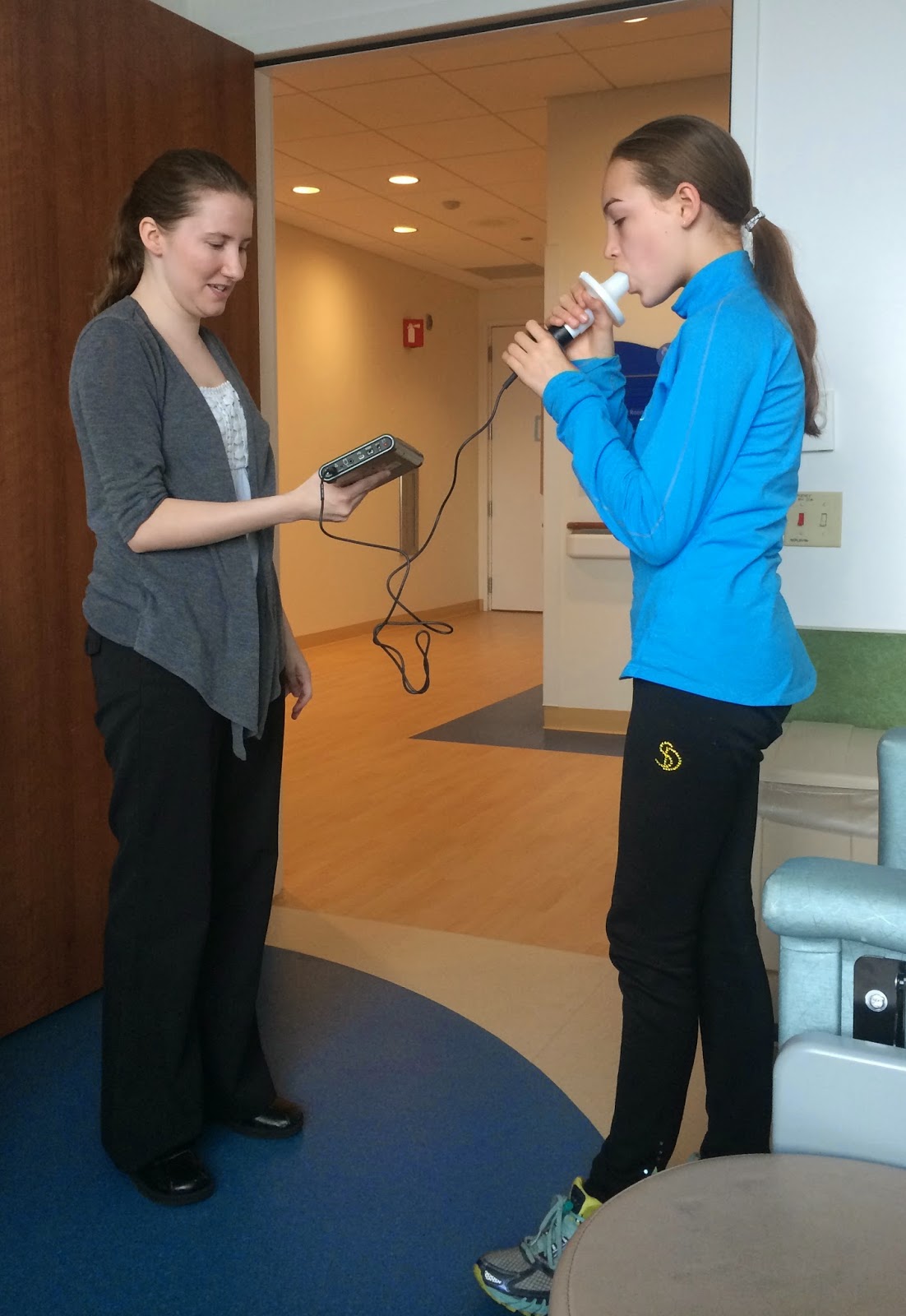
Susan was all business during the breathing tests. 

And I could not resist photographing the pre-prepared, clearly labeled syringes filled with what I hope is a miracle medicine for Susan...


[I have already had several people ask -- why THREE injections?  It does seem rather a lot, I would agree -- while I don't know the amount in each syringe (although I suspect I could have known had I thought to turn over the syringes), I do know that this is the dosage that was calculated based on Susan's IgE levels at the time she was enrolled in the clinical trial -- First Food Challenge.]

Susan was the most relaxed I have ever seen her during the injections.  (Of course, we were TOTALLY joking around with her...and I am sure it did not hurt knowing that she was receiving open label injections of Xolair.)


She went from serious...


To..smiling.  As mom, I know that is a for-real smile.  With hope like this, how could she not smile?


And then (because we were being really goofy -- and not a one of us in the room could sing AT ALL), Susan was cracking up!  (How could she not?  Even I was laughing at how pathetic we sounded...)

And then, even though she was getting an injection (her third), Susan was "licking up her baby bumblebee!"  I love that Lydia's mother's antics carried over as they did during this visit to the CRU (Surreal).


I could not help but grill Susan after the injections:
-- Did you feel anything any different?  
-- Was there anything AT ALL different?  Anything?  At ALL?  

No, mom.
(As I told myself -- it means nothing.  Right?  Right.  But still...I wonder...)

Because Susan is now in Week 0, everything starts again -- including the two-hour observation period post-Xolair injections (this is true for the first three injection visits). Allergic kids are allergic to things -- including...um, medication.  So, it is really important that they be observed after a new medication is introduced.

So, Susan and I settled in to wait.  We knew there would be a blood draw (SO last on Susan's list)...but, other than that, we had no great plans for the two-hour waiting period.  Wait. That's not true.  She intended to royally beat me at Bejeweled Butterflies...but, other than that, we had no real plans.

And then, the clinical trial coordinator offered us what can only be described as a gift (although I doubt she saw it that way, doubt she understood the significance of what she was offering us...).  She suggested that Susan take her 45 mg peanut dose during the post-Xolair injection window.  

We didn't talk about it, but, we didn't have to.
We were both thrilled.

She took care of ordering a pre-measured dose from the pharmacy (if I never had to measure a dose of peanut protein again -- especially in my own home -- it would be perfectly fine with me, although, of course, this is part of what we have signed on for, and I will continue...).


Then came the task of figuring out what Susan would take her peanut dose in.  Options were limited, as she WILL NOT do applesauce and she would prefer not to do chocolate pudding [oh, she knows she will have to eat chocolate pudding during the food challenge (or applesauce!), but, other than that, I think she is trying to avoid chocolate pudding...].  

I was so frustrated, because the clinical trial coordinator offered two very viable options -- ice cream and Italian Ice.  Both options were available on the CRU, but, they were so poorly labeled that I had to actually call both companies to find out whether or not there was risk of cross-contamination with peanut.  (I do not take issue with the fact that these products were available on the CRU, as this unit serves any number of children with various medical concerns -- but, I am ever so frustrated by our country's exceptionally poor food labeling laws.  That's "next" on my list.)  Neither product was safe.

Susan, who liked the idea of taking her peanut dose in the CRU for -- oh, let me count the endless number of reasons -- was more flexible about the vehicle in which she would take it than usual.  After discussing our dwindling options, she settled on yogurt.  I went down to the cafeteria, where I was pleasantly surprised to discover a wide array of yogurts.  Loving technology, I texted the options to Susan, who picked blueberry Yoplait.  She is lump-averse when she takes her dose (hence the regular use of the Bullet blender), and felt the blueberries would disguise any lumps...


See how happy she looks?
It was (unfortunately) fleeting...

As she prepared to take the first spoonful, she had one of those unusual (and predictive) burps...and then she vomited violently.  I was stunned.  So was she.  It happens so fast.  

As stunned as I was (I THOUGHT she was tolerating the 45 mg dose), I was almost relieved to have it happen while she was sitting there, in the CRU.  The doctor, who was not in the room at the time, did NOT miss the action, as there is a glass window between the office she was in and the room Susan was in.  No one has ever given any hint of disbelief when I have called to report these episodes of vomiting, but, still, I liked knowing that they had seen it happen.  

And then I was struck by a horrible thought -- what if the vomiting meant Susan wasn't tolerating the Xolair?!  Fortunately, given Susan's very recent history, no one thought that!

Pre-dose vomiting = Pause, Information Gathering, Consultation and then a Pow Wow.

In the end, Susan and I were given the opportunity to weigh in heavily on the question of dosing.  

Arguments in favor of holding Susan at the 45 mg dose:
-- Decreasing a dose (and we had already decreased her dose from 60 mg to 45 mg) can result in greater intolerance...(this is a theory...no more science in my mind than much of the rest of this...)
-- The fact (let's face it -- hope) that the Xolair (maybe even the three injections she received on this day) should begin to help with tolerance issues
-- Achieving tolerance of 45 mg would likely improve Susan's chance of reaching tolerance of 2000 mg
-- Safety concerns

Arguments in favor of decreasing Susan to a 30 mg dose:
-- Greater likelihood of tolerance going forward (this was short-term thinking)
-- Decreased stress on her body (mind, and soul)
-- The idea that if her immune system was less stressed, she might respond more favorably to the Xolair
-- Safety

Laid out as it is above, it seems pretty clear (retrospectively) that we should move to a 30 mg dose...but, it really was a difficult decision as we sat there with the doctor and the clinical trial coordinator.  I was clear that I could argue the decision both ways, as was the doctor.  In the end, when Susan said she wanted to decrease the dose to 30 mg, the decision was easy.  With no clear-cut, easy answer, Susan's clear preference made the decision easy. After all, in this land where Susan has so little control, I liked the idea of giving her some control...

A medication was added...

And the clinical trial coordinator called the pharmacy (again), which, in turn, provided us with a 30 mg dose of peanut protein. 


I went back down to the cafe and purchased my second blueberry Yoplait of the day, which Susan consumed without issue (phew!).

Then we had the small issue of what to do with the blueberry Yoplait yogurt that had the 45 mg dose of peanut in it.  I could not eat it, as the peanut is cut with flour (read:  gluten). And try as we might, we just couldn't get anyone on the CRU to eat it!

So, there it sat...
Lonely.
Alone.
(Contaminated.)


As we hung out, waiting for the two-hour observation period to pass, I turned the peanut dosage decision over and over in my mind.  While I was feeling relieved and thankful that Susan would be taking a dose she had tolerated fairly well (setting aside the vomiting-outside-M. Henry incident), I could not help but reflect on how difficult the road had been for the little ground we had achieved...

Susan's dosage road map.  Laid out this clearly gives credence to everything I have felt and said about how difficult this time has been for Susan, for me, for our family...a road nearly to nowhere (and back).

May 22, 2014  --  30 mg home dose
May 23, 2014  --  15 mg home dose
June 2, 2014  --  22 mg home dose
June 5, 2014  --  30 mg home dose
June 9, 2014  --  45 mg home dose
June 17, 2014 -- 60 mg home dose
June 20, 2014 -- 45 mg home dose
June 24, 2014 -- 30 mg home dose

If not for the three open label Xolair injections Susan received, I am sure we would both be incredibly discouraged...

As I sit processing the dates and dosages I laid out above, I am struck not only by Susan's perseverance, but by her doctors' perseverance.  This has not been an easy road.  And I am so thankful for their steady support through this time.

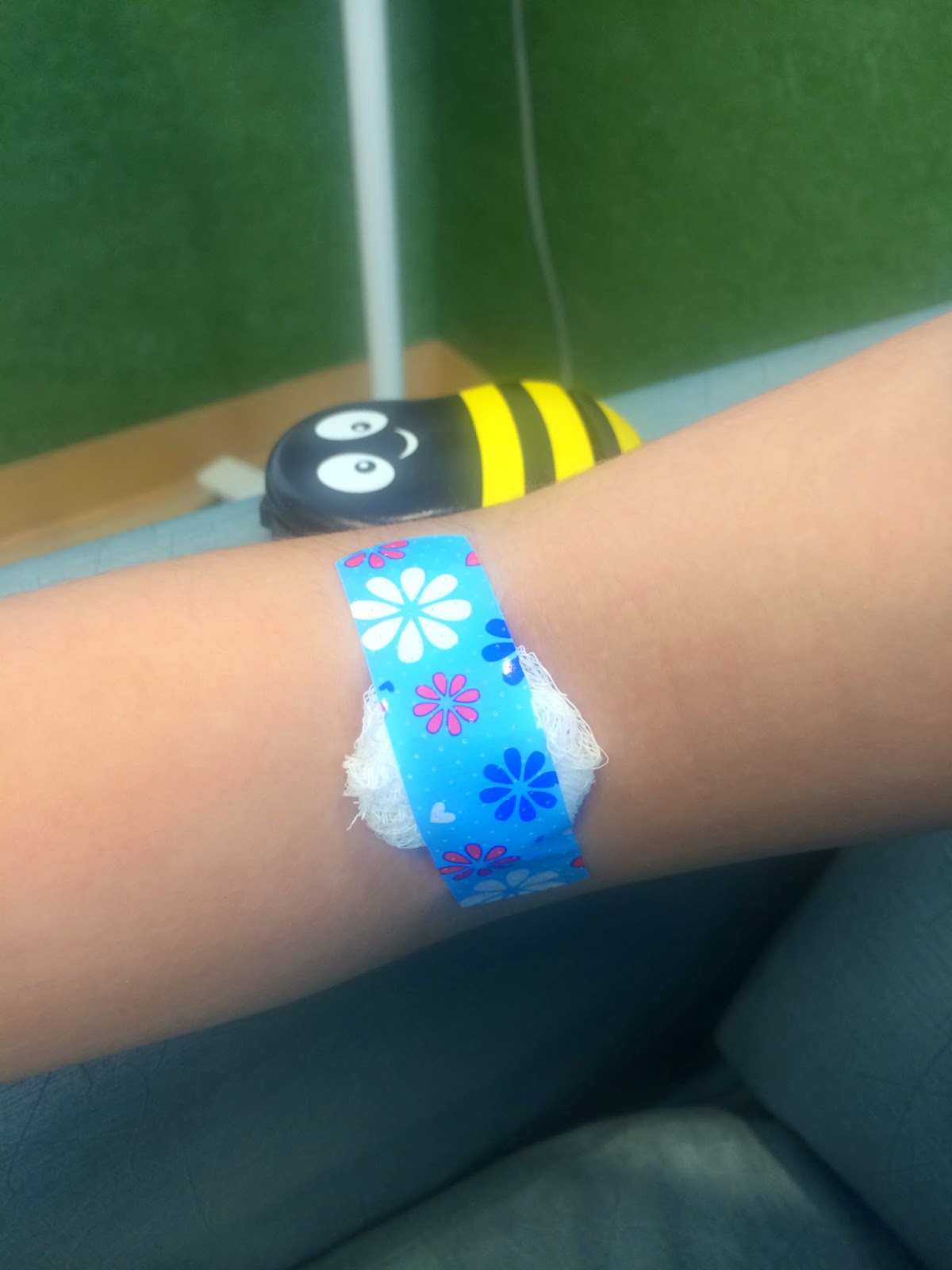
Week 0 included a blood draw, and the great nurses in the CRU brought out Buzzy Bee again. Having read the science behind Buzzy Bee, I am fairly certain it is not just his darling face that helps during painful procedures, but, it certainly didn't hurt that Susan giggled when we tucked Buzzy Bee into her sleeve...


And when the blood draw was over, Susan got an awesome flower-power Band-Aid.  The nurses actually buy fun Band-Aids and donate them to the hospital...Susan and I have begun collecting fun (latex free) Band-Aids...


Because, in a clinical trial for peanut allergies, the Peanuts Band-Aids the hospital has had for years simply don't do it!  


Sobering -- Current list of medications added since introduction of daily peanut dose:
10 mg Zyrtec -- morning
20 mg Famotidine -- morning
20 mg Omeprazole -- 1 hour before peanut dose

After two hours, we were cleared for departure (from the CRU).  I joked to Susan that maybe some day because of all that she is enduring now -- she will be "cleared for departure" for real.  It has been so many years since she has flown that she didn't get it.

We had a quick lunch at Maggiano's and then hit Barnes & Noble, where Susan found a new (to her) three-book series.  Susan was in a good mood -- the 30 mg dose felt very easy to her, and she was happy to have received the Xolair injections...

It was all good.

 Happy Skating Hands

With a darling skating buddy.